Abstract
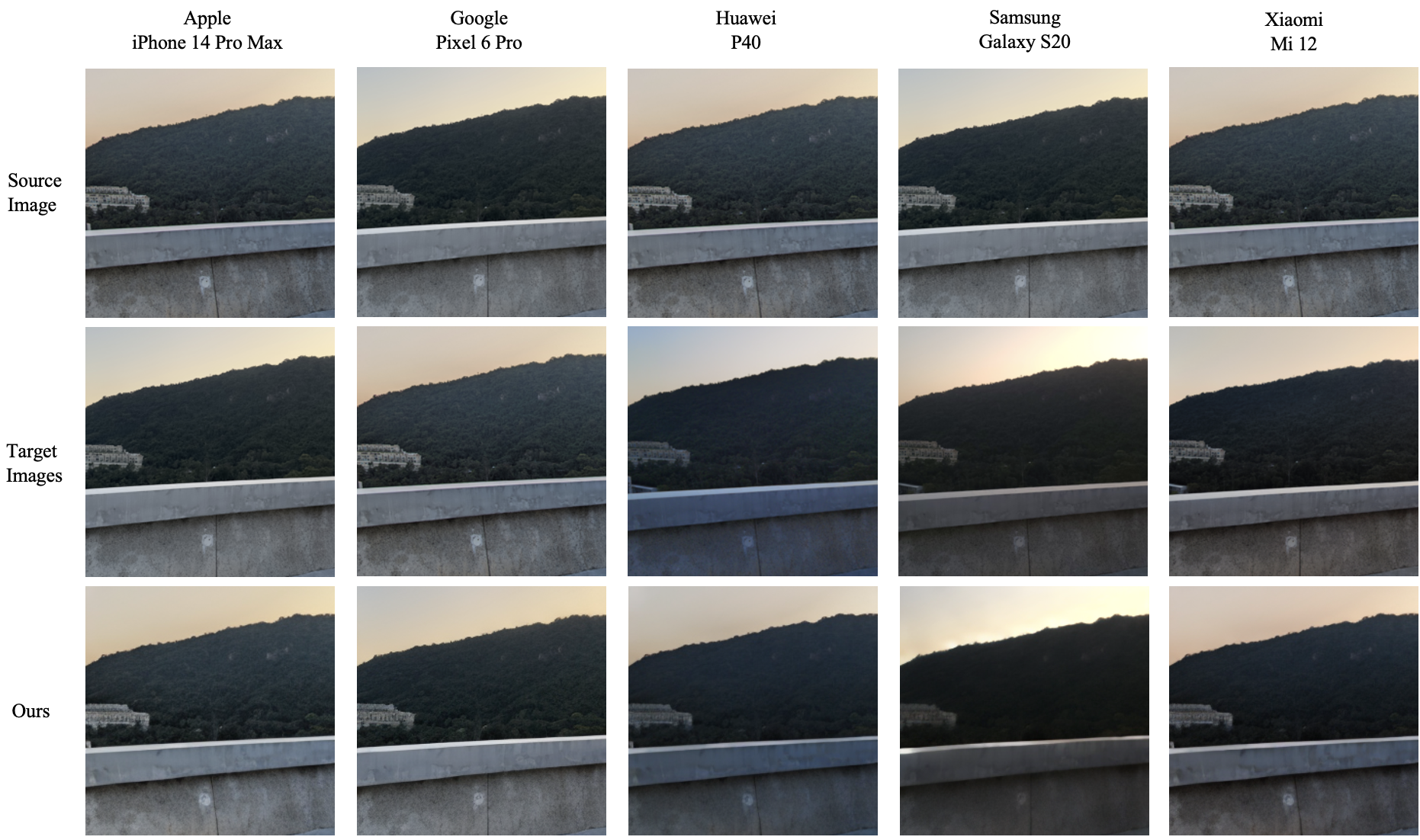
Modern camera Image Signal Processors (ISP) exhibit a series of complex, non-linear transformations that are highly device-dependent. Therefore, even the same scene appears differently across cameras, creating a barrier to consistent cross-device visual aesthetics. While deep learning methods have shown promise in modeling ISP transfer, existing models suffer from high computational cost due to transfer in pixel space, and are rigidly confined to a specific pair of device and domain. In this paper, we propose FlowISP, a framework for ISP style transfer that operates entirely in the latent space of a pretrained latent diffusion model. We furthermore formulate the style transfer task using Conditional Flow Matching, and introduce a specialized Diffusion Transformer (DiT) architecture that explicitly conditions temporal dynamics and device-specific ISP style separately. This design allows precise style manipulation while preserving the structure of the original scene. Experiments on multi-device ISP datasets demonstrate that FlowISP successfully reproduces target ISP aesthetics while strictly preserving scene geometry.
Why ISP transfer?
The Image Signal Processor is what turns a RAW sensor readout into the sRGB image you actually look at — demosaicing, white balance, tone mapping, colour correction. Every vendor tunes that chain differently, so two phones pointed at the same scene produce visibly different photographs.
That device dependence causes two problems. Editing models trained on one camera’s output degrade badly on another, because each ISP is effectively its own domain. And users are locked into whatever aesthetic their hardware ships with — wanting a different colour rendition today means buying different hardware.
ISP style transfer is the natural fix: given an sRGB image from a source ISP, produce the image that a target ISP would have made of the same scene. Prior work does this in pixel space with CNNs, GANs or diffusion models, which is expensive, sensitive to low-level noise, and demands pixel-perfect aligned pairs.
Our approach
Transfer in latent space. We encode both source and target images with the frozen Stable Diffusion VAE and learn the mapping between latents, decoding only at the end. The VAE is never fine-tuned, so we inherit its perceptual compression for free and pay a fraction of the pixel-space compute.
Flow matching instead of denoising. Standard diffusion maps noise to data. Here both endpoints are structured image latents, so we use the optimal-transport conditional flow — the straight line $z_t = (1-t)\,z_\mathrm{src} + t\,z_\mathrm{tgt}$ — whose ground-truth velocity field is simply $z_\mathrm{tgt} - z_\mathrm{src}$. Training regresses that velocity; inference integrates it from $t{=}0$ to $t{=}1$. The result is deterministic, with none of the stochasticity of noise-based sampling. Because the two endpoint distributions are so unlike noise-to-data, we train the transformer from scratch rather than adapting pretrained diffusion weights.
A disentangled DiT. The velocity field is parameterized by a Diffusion Transformer with two separate conditioning routes:
- Time enters through AdaLN — the timestep is a global property that describes how far along the interpolation we are. Following AdaLN-Zero, a zero-initialized gating scalar on each residual branch makes every block start as the identity, which stabilizes early training.
- ISP identity enters through cross-attention. Each device gets a learnable style embedding, looked up from a table by ISP id and injected as keys and values while the latent tokens act as queries.
Keeping the two paths apart lets the model modulate colour rendition without disturbing the temporal dynamics of the flow — and adding a new camera means adding one embedding, not retraining a device-pair-specific model.
Contributions
- Latent-space ISP transfer. We formulate ISP style transfer in the latent space of a frozen Stable Diffusion VAE, avoiding the cost of pixel-space training and lining up naturally with existing latent generative models.
- A flow-matching formulation for style transfer. We adapt flow matching from its usual noise-to-data setting to a deterministic image-to-image task, learning the continuous path from source-ISP to target-ISP latents.
- A disentangled DiT architecture. Temporal and stylistic information are injected through separate mechanisms, giving a modular conditioning scheme that extends to many ISPs.
Trained and evaluated on a multi-ISP dataset in which each scene is captured by several camera models, FlowISP produces smooth transfer across diverse ISP pairs while keeping scene structure and detail intact.
BibTeX
@inproceedings{kim2026flowisp,
  title     = {FlowISP: Latent Space ISP Transfer via Conditional Flow Matching},
  author    = {Kim, Taehyeon and Kim, Jinwoo and Kim, Seon Joo},
  booktitle = {Proceedings of the IEEE/CVF Conference on Computer Vision and
               Pattern Recognition (CVPR) Workshops},
  year      = {2026}
}